Snowtwin JournalPet memorials
A pet memorial snow globe, and other gentle ways to keep them close
What to do with the phone snapshots most of us have, how to give one without rushing anyone, and when a paw print or a tree is the better choice.
The oldest headstone at Hartsdale Pet Cemetery, on a hillside just north of New York City, belongs to a dog named Blague, who died in 1898. Some 80,000 animals have been buried there since, along with about 900 people who asked to lie near their pets, among them all four grandparents of Ed Martin III, whose family runs the place.
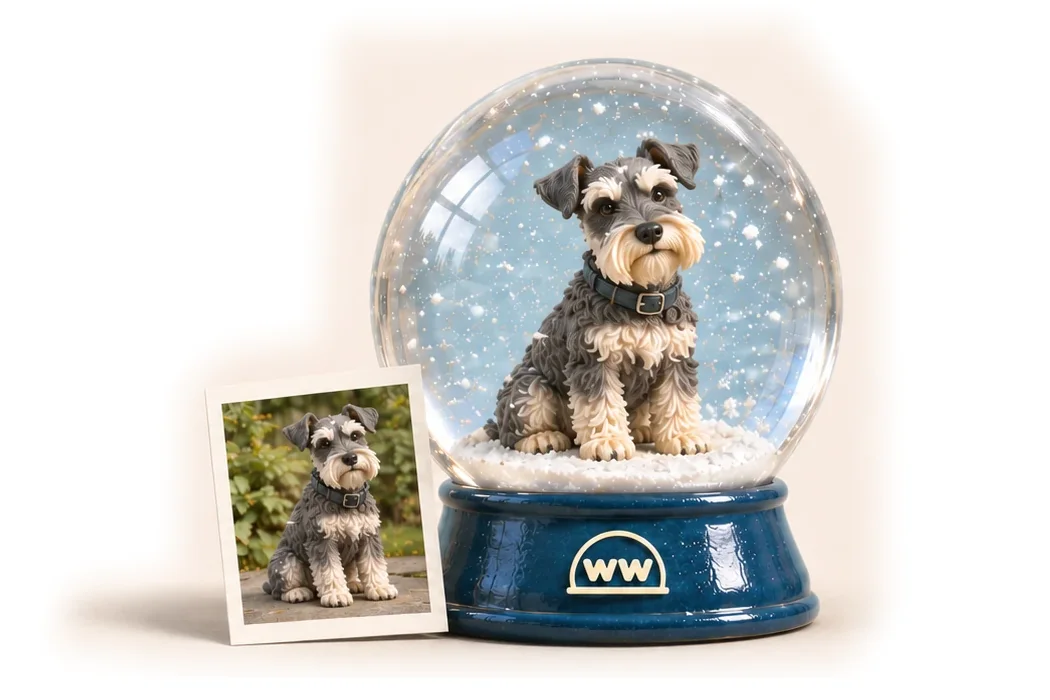
The urge to keep them close is old and ordinary. A pet memorial snow globe is one small, recent way of answering it. It won’t suit everyone, and I say that as someone who makes them.
When pets started getting headstones
Hartsdale opened in 1896. The cemetery’s own history credits the idea to Emily Berthet, who partnered with Dr. Samuel Johnson, a leading Manhattan veterinary surgeon. In 2012 it became the only pet cemetery among the 2,698 cemeteries then on the National Register of Historic Places, and Kevin Moriarty, a historian for the register, said in an Associated Press story that the early 20th century was when pets came to be seen as family members rather than livestock.
Before then, a dead animal was likely to go out with the garbage.

Paris followed in 1899, just outside the city. According to the town of Asnières-sur-Seine, dead animals in Paris mostly went out with the household waste or into the Seine until a law of June 21, 1898 allowed domestic animals to be buried in a pit, ideally 100 meters from homes, under at least a meter of earth. A lawyer, Georges Harmois, and a feminist journalist, Marguerite Durand, formed a company that bought half of an island in the Seine in June 1899. It became the Cimetière des Chiens.
The people who run these places know who the flowers and eulogies are for. Of the rituals at Hartsdale, Ed Martin III told The New York Times, “it’s not for the dead; it’s for us.” That’s a fair test for any memorial, ours included.
Grief that people don’t always make room for
In January 2026, Philip Hyland, a psychology professor at Maynooth University in Ireland, published a survey of 975 adults in the UK. About a third had lost a pet they loved, nearly all of those had also lost a person, and 21% of them named the pet’s death as their most distressing bereavement. By the study’s measure, 7.5% of people who had lost a pet met the criteria for prolonged grief disorder, close to the rate after losing a close friend (7.8%) and not far below losing a partner (9.1%). Officially, the diagnosis only applies after the death of a person.
Hyland calls that rule scientifically misguided, and callous. People already tend to see pet grief as less legitimate, he notes, and “many people grieving the loss of their pet feel embarrassed and isolated.” Researchers call this disenfranchised grief, a loss others don’t acknowledge and the bereaved can’t openly express. A 2019 study of 133 bereaved pet owners in the journal Anthrozoös found that when grief was severe, being disenfranchised held back posttraumatic growth, the positive change some people find after a loss.
Veterinary schools have taken this seriously for decades. The first pet loss hotline opened at UC Davis in 1989, according to Cornell, whose own line is staffed by veterinary students trained by professional grief counselors. I’m not a counselor, so instead of advice, here are people trained to listen.
Comfort for some people, an ambush for others
Grief researchers use the term continuing bonds for the effort to stay emotionally connected to someone after they die. A review of pet-loss studies by Ben Hughes and Beth Lewis Harkin, in the journal Omega, found that rituals, memorials and memories, even dreams about the animal, tended to ease grief, while bonds fixed on the negative could make it more severe. Some owners kept the bond going through another pet, and the review found no conclusive evidence on whether that eased grief or only postponed it. Worth knowing before anyone suggests a replacement.
The Anthrozoös study is less encouraging for people in my line of work. It found no relationship between how many memorials people had, or what kind, and posttraumatic growth. A globe on a shelf is not a treatment, and I’d distrust anyone who sold one as if it were.
Some people find a likeness of their dog comforting from the first day, and others find it ambushes them every time they walk past the shelf. Neither is wrong. If it isn’t clear yet which kind of person you are, wait.
If all you have is phone photos
Most of us have a camera roll full of pictures nobody meant as portraits, the dog asleep on the couch or the cat crossing the kitchen in a blur. That’s fine. What matters most is a sharp face, so zoom in on the eyes. If you can see the shine in them and the edge of each eyelid, the photo can carry the face. If not, keep it for color and markings and keep looking.
In a camera roll, the most useful shots are usually the ones taken from the floor, at the animal’s eye level; from standing height, most dogs turn into a big head on short legs. Daylight beats everything. A window or open shade shows true color, while flash flattens fur and makes eyes glow, and lamps at night push everything toward orange. A side profile is worth hunting for, because it shows the length of the nose and the set of the ears, which a front-on photo hides.
Black and white coats are the hardest. A black dog in dim light becomes a silhouette with eyes, so pick the brightest photo you have, even if the background is blown out. A white cat in direct sun loses all its texture. Phones and filters shift color too, so send original files rather than screenshots and say in words which photo looks most like the real animal. Darker than this one, closer to the one in the snow is exactly the kind of note that helps.
If only one photo exists, describe the rest in words: which ear stood up, the white sock on the back left foot, the gray that came in around the muzzle, how big they were next to the cat. And if your dog or cat is old or ill and still here, take a few now. Sit on the floor by a window and get the face, both sides and the back.
What makes it them and not just their breed
Getting color and proportion right makes a twin look like the breed. Recognition comes from smaller things. The collar they wore every day, even if the tag that clinked against the water bowl is too small to make it into the globe. The toy with the squeaker long since chewed out. The blanket, if they were never off it. If any of these show up in a photo, point them out; if they’re still in a drawer, photograph them on a table by a window.
Then there’s the pose. Most animals had one the whole family would know at a glance, like the head tilt at the word walk or the frog-legged sprawl on a cool kitchen floor. Cats have the loaf. One honest photo of that beats a sharper photo of a stance they rarely took.
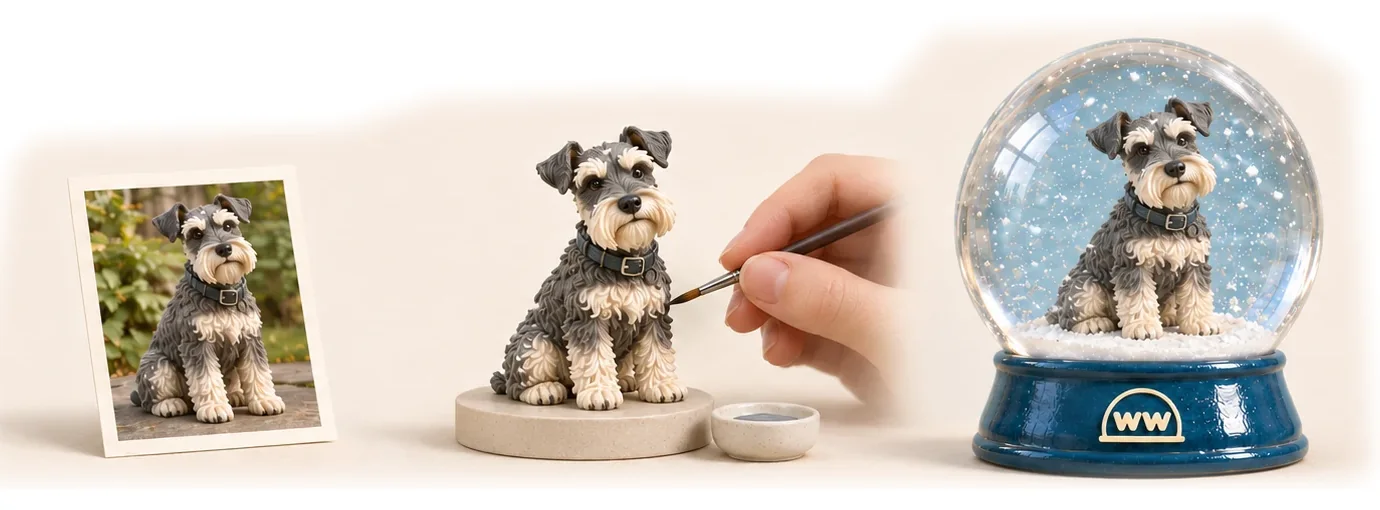
Choose an age, too. Some people want the dog in her prime, others the gray muzzle of the last year, because that’s who they said goodbye to. There’s no right answer, as long as you say which. For the details that survive the glass and the ones that don’t, see what you can put in a custom snow globe.
Giving a pet memorial gift without rushing anyone
Timing matters more than the object. Some people want a likeness of their dog right away. Others can’t look at photos for months, and a box that arrives unannounced can knock the wind out of them. Ask first, or have someone close to them ask. Letting them choose the photo helps too, and their answer tells you whether they’re ready.
Sometimes the right sympathy gift for the loss of a pet is a card and nothing else, with the globe, or whatever it turns out to be, offered later, at the first anniversary or the day they bring up a favorite photo themselves. A memorial gift for the loss of a dog the whole family loved doesn’t have to be an object at all. The ASPCA suggests remembering a pet in a way that includes others, and a card signed by everyone who walked him does that for the price of a stamp.
For the card, use the pet’s name and one true detail. Plain beats poetic.
- I’m so sorry about Pepper. I keep thinking about the way she leaned on your legs.
- Thinking of you and Biscuit today. No need to write back.
- Max made every visit to your house better. I’ll miss him at the door.
Leave out anything that starts with at least, and any suggestion of another pet. The research can’t say a new one helps, and they didn’t ask.
When something else fits better
Paw and nose prints are the one alternative with a deadline. They have to be made before cremation or burial, usually by the vet, and someone has to ask. Writing for the American Animal Hospital Association, the veterinarian Emily Singler described the sympathy card that came in the mail a few days after her 19-year-old cat, Comet, died. It carried handwritten messages from several of the practice team and inkblot impressions of Comet’s muzzle and paws. Prints are best for anyone who wants something taken from the animal itself, and as a dog or cat memorial gift they’re hard to beat. Buddies’ paw-print jewelry and accessories ran $60 to $695 on Lap of Love’s list of memorial products when we checked in November 2026.
A painted portrait belongs on a wall rather than a shelf, and it’s best for someone who would rather have an artist’s take than an exact likeness. Give the painter the same eye-level, daylight photos.
For a friend who doesn’t want more things in the house, give money in the pet’s name instead, and if the pet came from a shelter, give to that shelter. Cornell’s hotline, for one, runs mainly on private donations and accepts gifts in an animal’s memory.
People with a garden sometimes want somewhere to go more than something to look at. A tree does that, or a rosebush, or bulbs that come up every spring.

An urn, or something else made to hold ashes, is best for keeping the remains themselves close. To get a pet’s own ashes back, the ASPCA advises arranging an individual, or private, cremation, meaning the pet is cremated alone. On the same Lap of Love list in November 2026, a vase urn from Sky Urns was $165 to $195 plus $40 for engraving, and Petsies’ custom stuffed animals started at $199 with an optional pouch for ashes. Inside one of our globes is the sculpted twin. If the ashes are the point, buy something made to hold them.
If you’re weighing a globe against these, or a photo-insert globe against a sculpted one, our comparison of photo, handmade and 3D-printed snow globes has dated prices.
And if nobody’s ready to decide, don’t. Make a folder on your phone with their name on it, and whenever you come across a photo where the face is sharp and the light is kind, move it there. In a month or two you’ll probably know whether you want a globe, a painting, a tree or nothing at all, and the photos will be waiting either way.
Sources and further reading
- History, Hartsdale Pet Cemetery
- Who was the mysterious woman buried alone at the pet cemetery?, The New York Times (Andrew Keh), via NZ Herald (2024)
- New York pet cemetery recognized as historic place, CBC News (The Associated Press) (2012)
- Le cimetière des chiens d’Asnières-sur-Seine, Ville d’Asnières-sur-Seine
- No pets allowed: Evidence that prolonged grief disorder can occur following the death of a pet, PLOS One (2026)
- MU study finds death of a pet can be as intense as loss of a person, Maynooth University (2026)
- Pet Loss: Understanding Disenfranchised Grief, Memorial Use, and Posttraumatic Growth, Anthrozoös (2019)
- Pet Loss Resources and Support, Cornell University College of Veterinary Medicine
- Pet Loss Support Helpline, Cummings School of Veterinary Medicine at Tufts University
- Pet Loss Support Resource Center, Lap of Love
- Blue Cross Pet Loss Support, Blue Cross
- 988 Lifeline, 988 Lifeline
- The Impact of Continuing Bonds Between Pet Owners and Their Pets Following the Death of Their Pet: A Systematic Narrative Synthesis, Omega, via PubMed Central (2022)
- End of Life Care, ASPCA
- Memorializing deceased patients: An opportunity to strengthen the bond, AAHA NEWStat (2024)
- Pet Memorial Keepsakes, Lap of Love