Snowtwin JournalCustom snow globes
What can you put in a custom snow globe? Almost anything with a story
Water in a glass ball works like a lens, so a globe keeps a dog’s ears and a lit cabin window while quietly losing the fine print.
For their first 40 years of production, Perzy snow globes always held a church, the BBC reported in 2013. The very first held a pewter model of the pilgrimage basilica at Mariazell, south of Vienna, which Erwin Perzy had been molding for a friend who sold souvenirs to pilgrims. A custom snow globe today can hold nearly anything with a story, from a schnauzer to a first car.
Not all of it survives the shrink.
Perzy hadn’t set out to make souvenirs. Around 1900 he was a Viennese tradesman who built and repaired surgical instruments, and he had been asked for a cheap way to brighten hospital operating rooms. Shoemakers of the day set a water-filled glass ball in front of a candle, which threw a bright spot about the size of a hand. Perzy tried the trick with an electric bulb and found it didn’t work very well. Then one day he poured in semolina, the kind used for baby food. It sank so slowly that it reminded him of snowfall, and the pewter church went in next.
The dates are slippery. The family firm says it was founded around 1900, but The Henry Ford museum says water-filled glass snow globes were first shown at the Paris Universal Exposition of 1878. My read is that Perzy didn’t invent snow in a ball. His family is the reason it stuck, and they still make roughly 300,000 globes a year in Vienna’s 17th district.
A ball of water is a lens, and it plays favorites
Perzy’s company still describes the shoemaker’s ball as a water-filled glass that worked like a magnifying glass (the page is in German). A physics demo at the University of Colorado Boulder shows the effect with a 10-centimeter water-filled sphere that makes a suspended marble look bigger than a reference marble.
The lens can even be a hazard. In December 2008 Hallmark recalled 7,000 jumbo snowman globes because in sunlight they could work like a burning glass and ignite nearby materials. Hallmark had two reports of exactly that. Keep globes off sunny windowsills.
Inside a custom globe the lens mostly works for you, since it enlarges the figure, but it plays favorites. Through curved glass, with flakes drifting past, the eye takes in the outline and posture first and a color or two after that. Fine things go soft. Lettering and small logos blur into texture, a leash or a guitar string thickens or vanishes, and a busy background turns to noise.
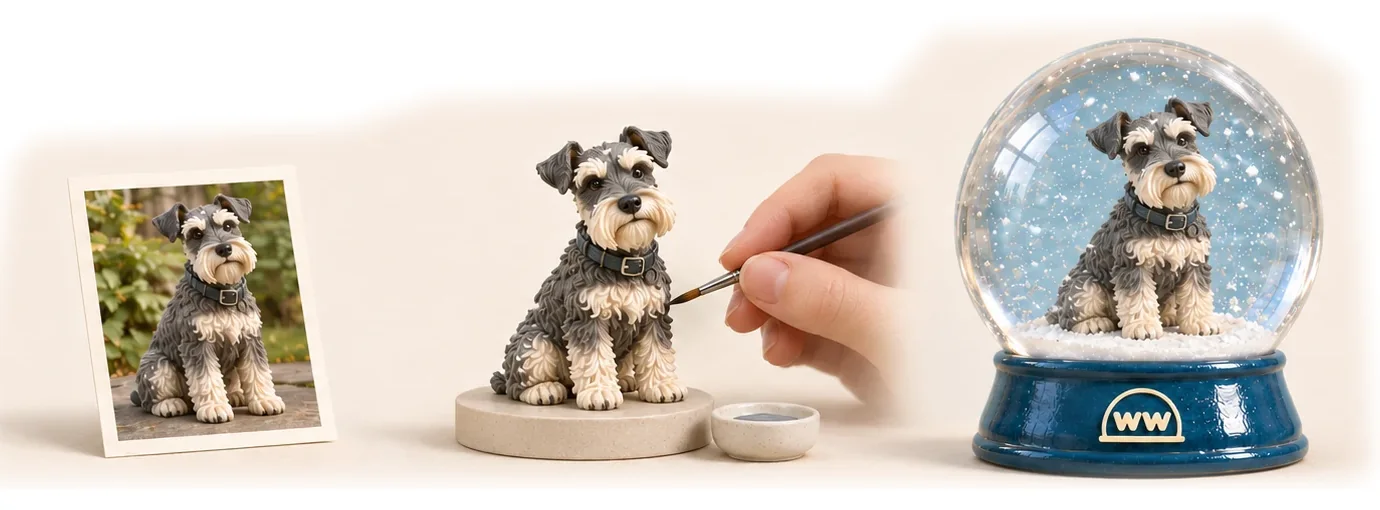
The stage is small, too. The Perzy shop sorts its globes into four diameters, from 25 to 120 millimeters, roughly one inch to just under five. At Snowtwin we sculpt each subject in 3D from a photo and paint it by hand (how it works), so the photo is where the likeness starts.
I go by distance. If you’d recognize the subject from across a room, it will read in a globe. If you’d have to lean in, it probably won’t.
| Subject | What reads well | Photos to send | Watch out for |
|---|---|---|---|
| Dogs | Ear shape, coat color, markings, the usual sit | Eye-level face, full side view, markings | Leashes, tags, fine fur texture |
| Cats and other animals | Markings, eye color, the pose they always take | Face in daylight, whole body from the side | Look-alike outlines, thin legs and beaks |
| Couples, kids, grandparents | Hair, eyebrows, glasses, solid colors, how they stand together | Each face, plus one full-length shot | Big groups, busy prints |
| Someone who has died | The face people remember, a familiar hat or sweater | The photo that looks most like them | Formal portraits that look like someone else |
| Houses, cabins, venues | Roofline, windows, front door, paint colors | Straight-on front, plus a corner view | Trees hiding the facade, house numbers |
| Landmarks and travel spots | One building or one silhouette | The view from where you stood | Skylines, needle-thin towers |
| Cars, motorcycles, guitars | Body shape, paint or finish, wheels or headstock | Three-quarter view at headlight height, side profile | Plates, badges, spokes, strings |
| Storefronts, mascots, products | Facade, mascot outline, product shape and color | Straight-on photo, brand colors, product on white | Small print, long names, detailed logos |
With dogs, the ears do most of the talking
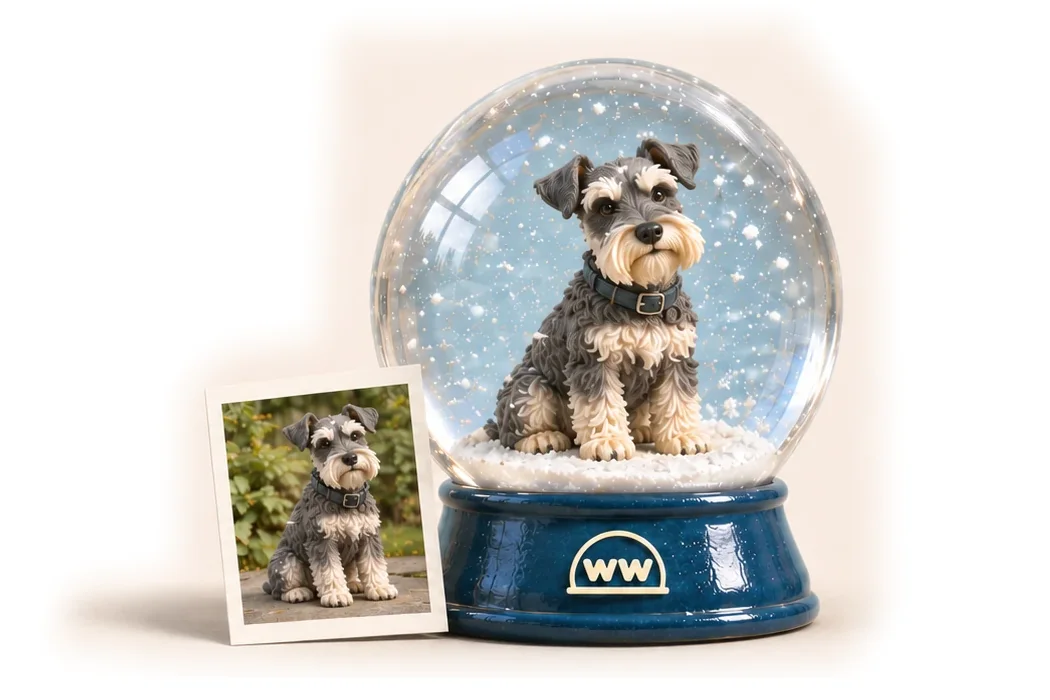
Most dogs have a mark or two that no other dog has, and it’s rarely what the owner points the camera at. The patch over one eye. The nick in one ear. Get those right and a custom snow globe of your dog looks like your dog instead of the breed.
Ears set the silhouette, so they matter more than people expect. Fill a corgi in solid black and you’d still know it by the ears. At globe scale they’re half the likeness and posture is most of the rest, so if your dog always sits with one hip kicked out, send the photo that shows it.
Cats are harder. Two gray tabbies can share a silhouette, so the markings and eye color have to do everything. Photograph them in daylight; lamplight turns a gray cat beige.
Long legs are a trap. A standing horse or heron is mostly thin vertical lines, and it reads better tucked into a pose, like a horse lying in the grass. Fish are old hands at this. A 1929 US patent for a liquid-filled glass globe already described a small fish and waving grass moving freely in the liquid.
Shoot at eye level, in daylight. Snowtwin’s FAQ asks for much the same thing, a clear, well-lit photo of the details you most want to keep, plus extra angles for what one view misses. For a pet who has died, often all that’s left is the camera roll, and that’s where the pet memorial snow globe guide begins.
A personalized snow globe of a person runs on eyebrows
Faces worry people most, and they can relax a little. In a paper summarized by Phys.org in 2007, MIT’s Pawan Sinha and colleagues reported that people recognize familiar faces even in very low-resolution images. The authors suspect we got good at it because we so often have to recognize each other at a distance and in motion. Of all the features, people leaned hardest on the eyebrows, not the eyes, and skin tone mattered at least as much as the shape of the face.
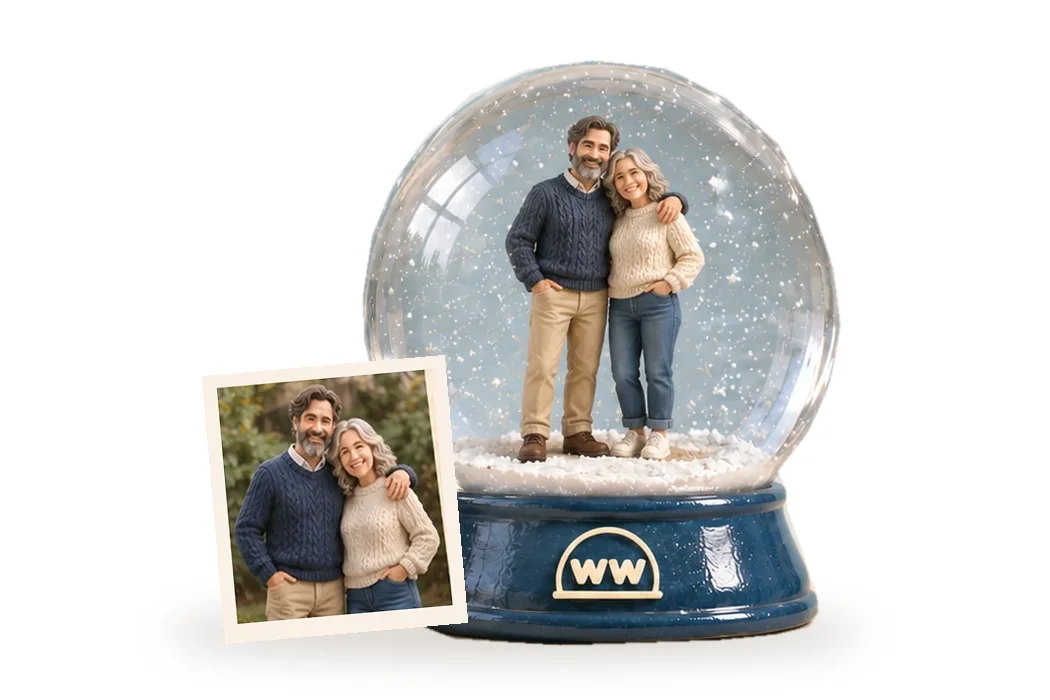
A globe on a shelf gets looked at the same way, from a few feet off and through falling snow. The hairline, the eyebrows, the glasses and the set of the shoulders carry most of a person’s likeness, and paint carries the rest. Color deserves as much care as the sculpting.
Couples live in the space between two people, in who leans on whom and where the hands go. Solid colors help, and so does a pose you’d recognize from a hundred photos. At a wedding, the couple isn’t always the best subject for a wedding snow globe. Often the venue is.
Kids change fast, so choose the age on purpose. Costumes are excellent at this scale, since a cape and a mask are pure silhouette and color. Grandparents read by posture and by what they always wear, the flat cap or the reading glasses on a chain.
When the person in the photo has died
A memorial snow globe made from a photo of someone who has died is possible, and the hard part is choosing the photo. Pick the one that looks like them, not the most formal one. A studio portrait can be the sharpest picture in the box and still look like a stranger, while a soft snapshot from a birthday dinner has the face everyone remembers. If the best face and the best outfit are in different photos, send both.
Sometimes the better memorial is something that was theirs, like the truck or the porch swing. If you’re buying for someone who is grieving, or grieving yourself, MedlinePlus keeps a page of bereavement resources. For a pet, our pet memorial guide lists support lines in the US and UK, checked in November 2026.
A house shrinks better than a skyline
The best-known snow globe in film holds a house. As Citizen Kane opens, Charles Foster Kane lies alone in the dark, holding a globe with a snow-covered wooden cabin inside. The BBC stated in 2013 that the globe in the 1941 film was a Perzy, but Atlas Obscura reports that no records confirm the maker. When Erwin Perzy III built his own replica, he gave the cabin golden light in the window, and that’s the right instinct. A lit window is one of the strongest signals a house has at globe scale.
It’s a separate world inside the snow globe. It’s an escape.
Houses take to a globe because a house is mostly outline and color, the roofline and the rhythm of the windows. What gets lost is the clutter around it, like the big tree out front and the house number. For a house snow globe, send a straight-on photo of the front in daylight and a second from a corner to show depth. The house snow globe guide covers housewarming, first-home, childhood-home and closing gifts.
Cabins and wedding venues work the same way if you pick one building. A barn venue with its doors open reads well. The barn plus the tent plus the string lights plus the guests is a crowd scene.
Landmarks are the souvenir trade’s home ground. Most globes in The Henry Ford’s collection were sold to tourists as souvenirs in the second half of the 20th century. In Vienna, the Perzy shop sells a 45-millimeter globe called Steffl & Riesenrad. Steffl is the Viennese nickname for St. Stephen’s Cathedral, and the Riesenrad is the city’s Ferris wheel. It was listed at €11 when we checked in November 2026. A landmark snow globe works when it commits to one or two silhouettes and leaves the rest of the city out. A travel spot is no different, so the chapel from the trip beats the view from the hill.

Toy-car designers never scale straight down
Hot Wheels designers face this problem at 1:64 scale. Shrink a real car faithfully, designer Brendon Vetuskey told Popular Science, and “the wheels would look too small, the roof would look too big.” So his team exaggerates and adjusts details until the car looks right small. On a 1970 Pontiac Trans Am, that meant the open engine bay and the side-exiting exhaust pipes, adjusted until the proportions made sense.
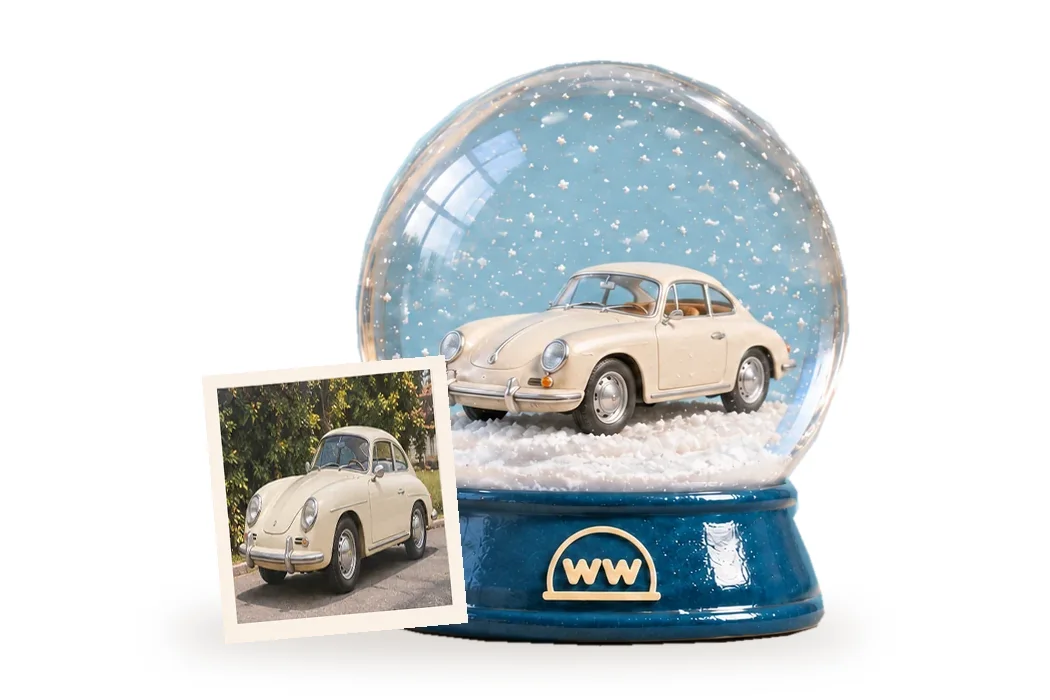
A car snow globe works the same way. Body shape and paint color carry it and the wheels help, while plates, badges and mirrors mostly don’t make it. Send a three-quarter view from headlight height and a side profile, in daylight so the color is true.
Motorcycles are harder. A bike is mostly air and thin parts, exactly what curved glass erases, so the tank, the seat and the stance end up doing all the work. Put the rider on it. A guitar keeps its body shape and finish while the strings go first, and one in someone’s hands reads better than one floating alone.
Business globes and the trouble with logos
Business got into snow globes early. Joseph Garaja, the Pittsburgh inventor whose 1929 patent changed how globes were assembled, described his as a holder for any desired object, advertising included. It’s the same patent with the fish. The Perzy workshop has made limited runs for corporate clients like McDonald’s, and in 2013 custom orders were a fifth of its sales.
Brands are built out of text, and text goes first. A storefront reads like a house, by its awning color and its door, while the sign above it blurs. Mascots are the easiest business subject there is, since a good mascot is designed to be recognized small. Products come down to shape. A bottle with a distinctive outline works; a phone or a box of tea is a rectangle with words on it.
Snowtwin for Business works with brands, teams and events. If the point is a legible logo or slogan, though, a photo-insert globe is probably the better tool, because a Snowtwin holds a sculpted twin rather than a picture. Our comparison of photo-insert, handmade and 3D-printed globes lays out the tradeoffs.
Thirty cousins and a giraffe
Some subjects fight the format. Every figure you add makes each one smaller, and past a handful nobody is recognizable, so the reunion photo with 30 cousins belongs in a photo-insert globe or a frame. Or put the whole family in the globe as the house they grew up in.
Words go the same way. Diplomas, jerseys with long names, book covers and script tattoos lose their lettering first, since lettering is exactly what a lens and moving snow blur. Put the words on the card instead.
Snow globe or snowdome, the inside is round, and round is bad news for anything tall and thin. An Eiffel Tower or a giraffe has to shrink until its height fits, and then it’s a needle. (Not that this has ever stopped anyone. Smithsonian magazine, citing a thesis by Anne Hilker, reports that the earliest snow globe whose contents and date can both be established held a miniature Eiffel Tower from the Paris Exposition of 1889.) Choose a part instead, like the giraffe’s head and neck leaning in from one side.
The hardest to give up are subjects that aren’t shapes at all. A song, a laugh, the dog’s zoomies, the roar of one particular waterfall.
A globe holds still.
Erwin Perzy III once told the BBC that his globe has “nothing, no battery, no nothing,” and he wasn’t complaining. Children who tour the factory, he said, end up wide-eyed, shaking one or two globes at a time. If the meaning is a sound, give the recording and let the globe sit beside it. If it’s motion, freeze the moment that implies it, the dog at the top of the leap or a first wobbly step.
Sources and further reading
- The family company that invented the snow globe, BBC News (2013)
- How an Experiment to Amplify Light in Hospital Operating Rooms Led to the Accidental Invention of the Snow Globe, Smithsonian Magazine (2024)
- Geschichte (history of the Original Wiener Schneekugel), Original Wiener Schneekugelmanufaktur
- Snow Globes: Objects of American Culture and Personal Contemplation, The Henry Ford (2023)
- Spherical Water Lens, University of Colorado Boulder, Physics Undergraduate Labs
- Hallmark Recalls Jumbo Snow Globes Due to Fire Hazard, U.S. Consumer Product Safety Commission (2008)
- 45 P Steffl & Riesenrad, Original Wiener Schneekugelmanufaktur
- US1741692A: Paper weight, Google Patents (1929)
- For computer scientists exploring face recognition, the question is ‘who?’, Phys.org (2007)
- Bereavement, MedlinePlus, U.S. National Library of Medicine
- This Family Gave the World the Snow Globe, Atlas Obscura (2022)
- File:Snow Globe Bozen-Bolzano.jpg, Wikimedia Commons (2016)
- A look inside the design center where Hot Wheels creates its timeless toy cars, Popular Science (2022)